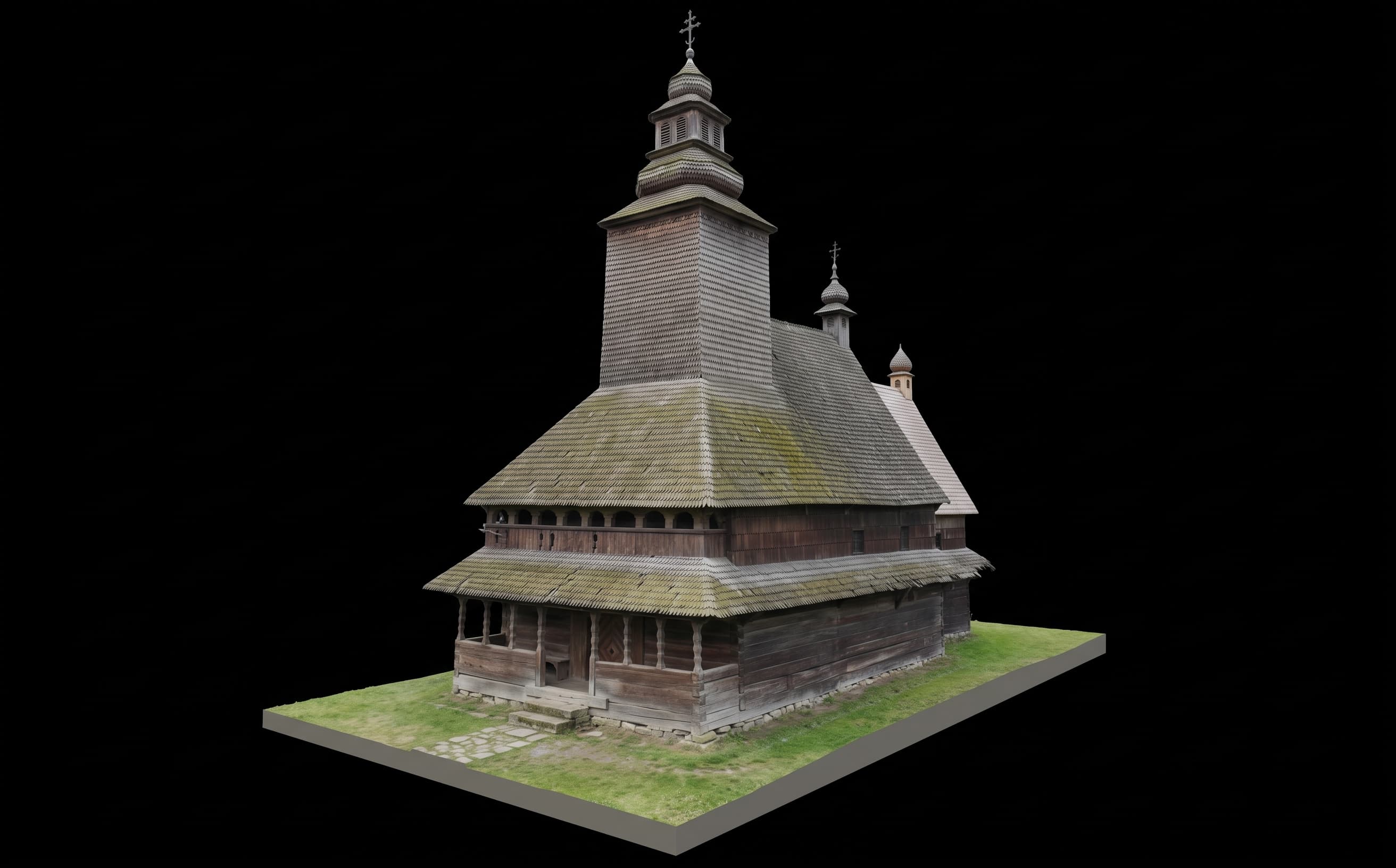
Church of the Holy Spirit
About object
Among Kolochava’s most notable monuments is the wooden Church of the Holy Spirit, one of the principal sacred landmarks of this historic village in Khust District. The church is generally dated to 1795, as indicated by the inscription on its doorjamb, though some scholars believe that in that year it was only moved to a new site and that the building itself may be older. The long inscription also records the parish priest, the master builder Ferenc Hekk or Tekk, and the broader historical context of a severe famine during the reign of Franz II. In the twentieth century the church was closed, used as a storehouse, and stripped of much of its interior; in 1975 its iconostasis and many movable objects were transferred to Uzhhorod. Since 1969 the building has functioned as a museum. Architecturally, the church belongs to the Zakarpattian school of vernacular sacred architecture and is accompanied by a separate square bell tower with a tent roof. The church itself is four-part, with two principal log-built units and one upper roofed structure, and is covered with hewn shingles. A west gallery on carved posts leads to the entrance, while a second-level gallery above it strengthens the picturesque vertical composition. An encircling pent roof surrounds the body, and the roofs of nave, apse, and bell tower are enriched by lanterns, blind lanterns, and pear-shaped cupolas crowned with metal crosses. Inside, the narthex and apse have flat beam ceilings, while the nave is covered by a near-barrel vault. Most historic decoration is lost, but the church remains important for its architecture and for its later role as a container of displaced religious heritage.
Work in progress
This section will be available soon.
Models
Work in progress
This section will be available soon.
Images