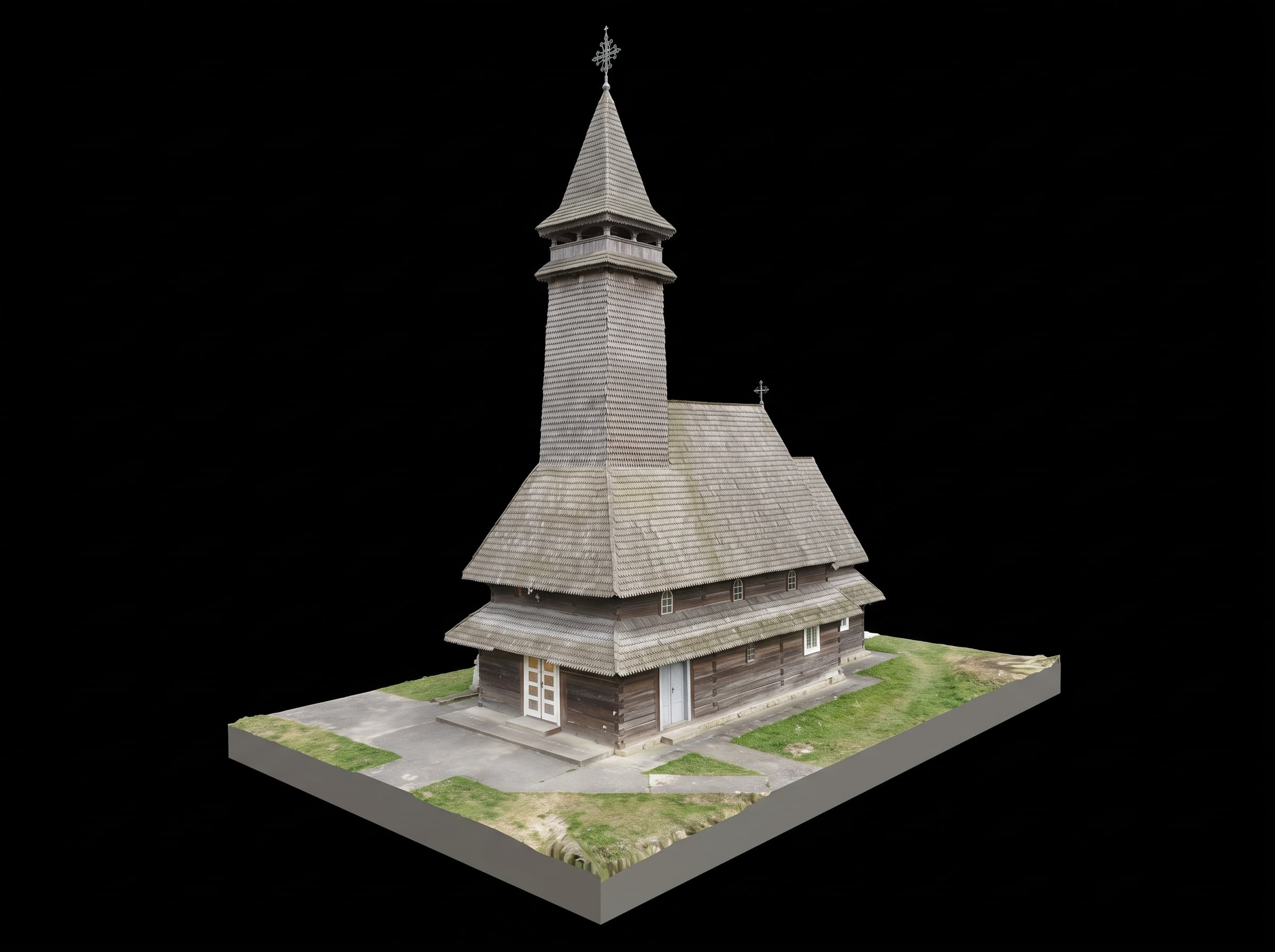
Church of Saint Nicholas
About object
The lower Church of Saint Nicholas in Serednie Vodyane is one of the most important wooden churches of the southern Maramureș tradition in Zakarpattia. Recent dendrochronological research indicates that the main body of the church was erected in 1641–1643, while the tower timber was prepared somewhat later, around 1698–1699, confirming that towers were often added after the church itself. The church served the lower part of the village of Serednia Apsha, a historic Romanian settlement now known as Serednie Vodiane, and could accommodate up to nearly 300 worshippers. It stands in an old cemetery on a hill and belongs to the local building tradition of travelling Maramureș master carpenters. Architecturally, the monument is part of the Zakarpattian school and of the group of churches with Gothic spire-like terminations and roofs set at different levels above the altar and the main body, locally described as Maramureș Gothic. Its bell tower, with belfry openings, board cladding, flared eaves, and a two-barred cross, forms a highly expressive vertical accent. Inside, the church preserves a trapezoidal-vaulted narthex, a nave with a barrel-vaulted ceiling and flattened crown, and an apse with a flat covering and a small inner dome in the form of a cloister vault. The artistic furnishing is also of exceptional interest: although the iconostasis has losses and modern replacements, much of the festive and apostolic material survives, together with the final “Gloria” composition. Equally valuable is the narthex wall painting, where traces of Saint Nicholas, Resurrection scenes, and other polychrome images preserve the character of the historic painted interior.
Work in progress
This section will be available soon.
Models
Work in progress
This section will be available soon.
Images