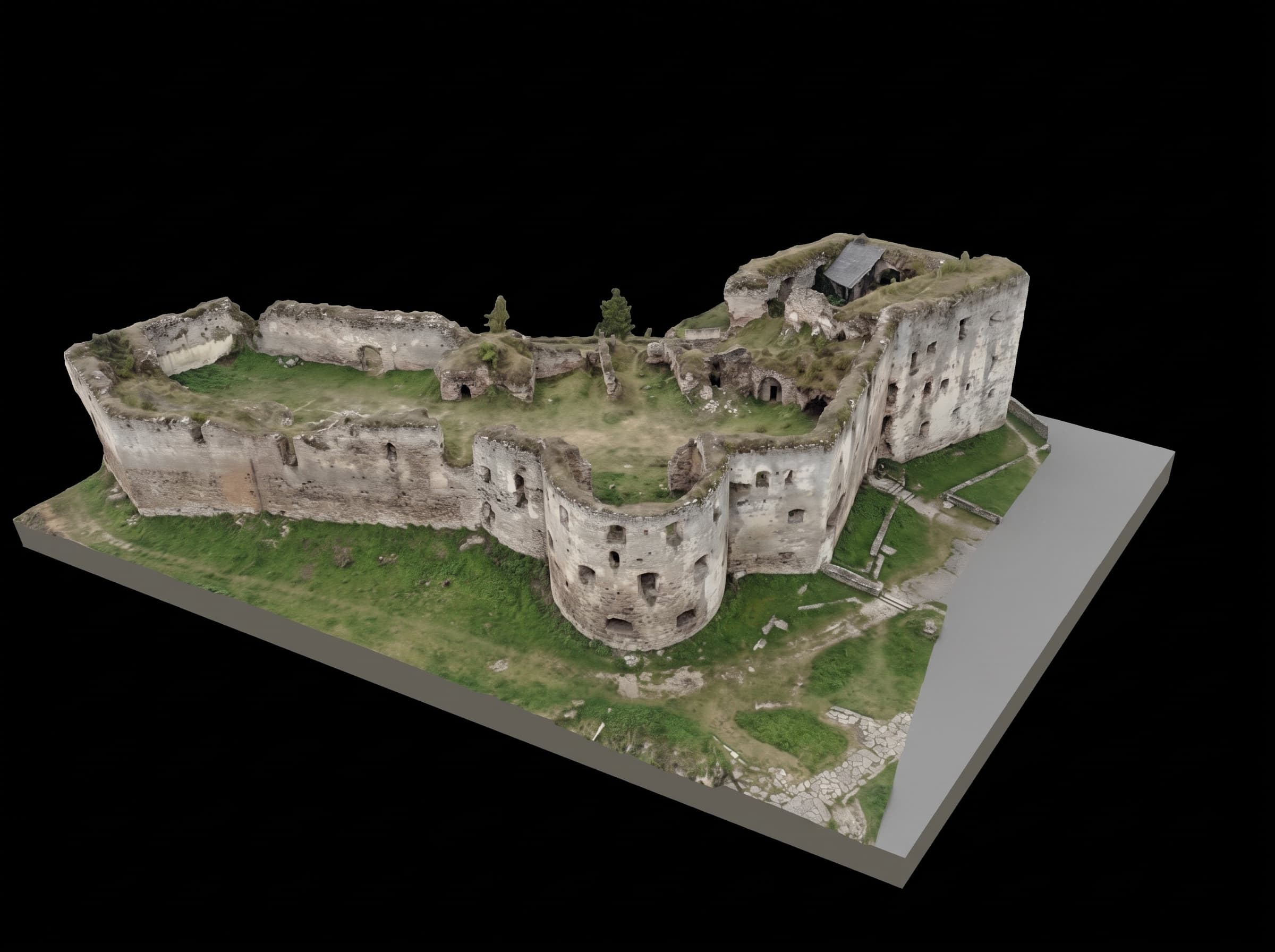
Yazlovets Castle
About object
Yazlovets Castle is a prominent complex of defensive and residential structures of the 14th–17th centuries in the village of Yazlovets, Ternopil region, which in the 16th century was considered one of the best in Ukraine. The complex consists of two parts: the Upper Castle on the highest point and the Lower Castle, which was later rebuilt into a palace. The first written mention of the castle as the residence of the Buchatskyi feudal lords dates back to 1436. The Upper Castle has an irregular, elongated pentagonal shape, determined by the relief of the hill, and contains the oldest part — a square tower. In 1550–1556, the Voivode of Podolia, Jerzy Jazłowiecki, rebuilt the castle in the Renaissance style, reinforcing it with a massive five-tiered keep (donjon) with triple embrasures. Above the entrance gate of this tower, a carved white stone portal with the Jazłowiecki coat of arms is visible. In 1649–1658, Aleksander Koniecpolski surrounded the Upper Castle with an outer defensive belt, creating the Lower Castle. Later, in 1747, the Castellan of Kraków, Stanisław Poniatowski, reconstructed the Lower Castle into an elegant U-shaped Baroque palace built of stone and brick. Despite the fact that the castle was considered a strong outpost, in 1672 it was captured almost without a fight by the Turkish army and later suffered significant destruction during the occupation. Since 1863, part of the complex has belonged to the monastery of the Congregation of the Sisters of the Immaculate Conception of the Blessed Virgin Mary. Currently, the ruins of the Upper Castle are part of the National Reserve "Castles of Ternopillia," where repair and conservation works are ongoing.
Work in progress
This section will be available soon.
Models
Work in progress
This section will be available soon.
Images